
Gas Sensors in Automotive Applications: Technologies, Design Flow, and VLSI Implementation
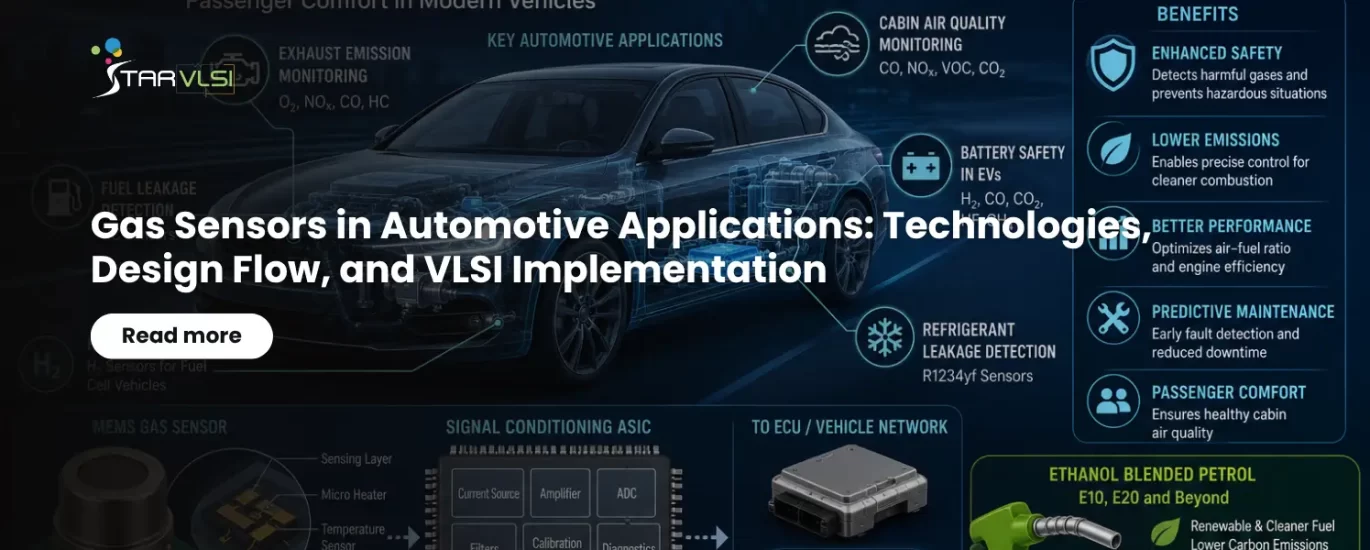
Gas sensors have grown from a niche exhaust-monitoring component into a core safety and diagnostic subsystem across the modern vehicle — covering emissions, ethanol-blended fuels, cabin air quality, fuel leakage, EV battery safety, refrigerant leaks, and hydrogen monitoring. This article covers where gas sensors are used in vehicles today, the sensing technologies behind them (MOS, electrochemical, catalytic bead, NDIR, MEMS), the architecture of a modern MEMS gas sensor, the signal-conditioning ASIC that reads it, and the VLSI and functional-safety considerations that go into building one for automotive use.
Gas Sensors in Modern Vehicles
The automotive industry is rapidly evolving toward intelligent, connected, and environmentally sustainable vehicles. Along with traditional sensors such as temperature, pressure, and inertial sensors, gas sensors have become an essential component in modern automobiles. These sensors continuously monitor the chemical composition of gases present inside the vehicle, around the passenger cabin, within the powertrain, and in electric vehicle battery systems. The information gathered enables the vehicle to improve passenger safety, reduce emissions, optimize engine performance, and predict system failures before they become critical.
The increasing adoption of electric vehicles, stringent emission regulations such as Euro 7 and Bharat Stage VI, and growing emphasis on vehicle health monitoring have significantly expanded the role of gas sensing technology. Modern gas sensors combine MEMS technology, precision analog front-end electronics, mixed-signal ASICs, embedded intelligence, and AI-based algorithms to deliver highly accurate and reliable measurements under harsh automotive operating conditions.
Modern automobiles contain hundreds of electronic sensors that continuously monitor various operating conditions. While mechanical sensors monitor physical parameters such as speed, pressure, and temperature, gas sensors provide valuable chemical information that cannot be detected by conventional sensing methods. The ability to detect invisible gases allows vehicle control systems to identify hazardous situations at a very early stage — harmful gases entering the passenger cabin, fuel leakage, battery failures, refrigerant leakage, or deterioration of engine combustion can all be identified long before they become safety risks. As vehicles become increasingly software-defined and autonomous, gas sensing is evolving into a critical subsystem within automotive electronics.
Exhaust Emission Monitoring
One of the earliest and most widely adopted applications of gas sensors is exhaust emission monitoring. Internal combustion engines require precise control of the air-fuel mixture to maximize fuel efficiency while minimizing harmful emissions. Oxygen sensors, commonly known as Lambda sensors, continuously measure the oxygen concentration in the exhaust stream and provide feedback to the Engine Control Unit (ECU). Using this information, the ECU adjusts the fuel injection timing and quantity to maintain the ideal combustion ratio.
Modern emission control systems also incorporate Nitrogen Oxide (NOx) sensors that help optimize Selective Catalytic Reduction (SCR) systems, ensuring emission regulations are satisfied while maintaining engine efficiency. Additional gas sensors monitor hydrocarbons, carbon monoxide, and particulate emissions, allowing advanced diagnostic systems to detect catalyst degradation and exhaust system failures.
Ethanol-Blended Petrol and Its Impact on Automotive Gas Sensing
Many countries, including India, have adopted ethanol-blended petrol as part of their strategy to reduce dependence on fossil fuels, lower greenhouse gas emissions, and support renewable energy initiatives. The widespread introduction of E10 and E20 fuels has brought new opportunities as well as engineering challenges for automotive manufacturers. Since ethanol possesses chemical properties that differ significantly from conventional gasoline, modern ECUs must continuously adapt combustion parameters to maintain engine performance, fuel economy, and emission compliance.
From a sensing perspective, ethanol influences the air-fuel ratio, combustion temperature, ignition characteristics, exhaust oxygen concentration, and hydrocarbon emissions. Consequently, exhaust oxygen (Lambda) sensors, NOx sensors, and other emission monitoring sensors play an even more critical role in vehicles operating with ethanol-blended fuels, providing real-time feedback that allows the ECU to dynamically adjust fuel injection timing, ignition advance, and exhaust after-treatment systems to compensate for changes in fuel composition.
Ethanol offers several environmental and performance advantages: it's a renewable fuel produced from biomass such as sugarcane and corn, its higher octane rating improves knock resistance and enables higher compression ratios, and it promotes cleaner combustion that can reduce carbon monoxide and certain hydrocarbon emissions when the engine is properly calibrated.
However, ethanol also presents engineering challenges. Because it contains less energy per litre than gasoline, higher blends such as E20 generally result in a modest reduction in fuel economy. Ethanol is hygroscopic, meaning it readily absorbs moisture from the atmosphere, which can accelerate corrosion in fuel system components not designed for higher ethanol concentrations, and can affect the durability of rubber seals, fuel hoses, injectors, and certain metallic components in older vehicles. Cold-start performance may also degrade in low-temperature environments because ethanol vaporizes less readily than gasoline.
Modern flex-fuel and ethanol-compatible vehicles overcome these challenges through advanced engine management systems, precise fuel injection control, adaptive ignition algorithms, and continuous feedback from oxygen and emission sensors. Future systems are expected to incorporate improved fuel composition sensors capable of directly estimating ethanol concentration, allowing ECUs to optimize combustion in real time.
Where Else Gas Sensors Keep the Vehicle Safe
Beyond the tailpipe, gas sensors are now spread across the cabin, fuel system, battery pack, and HVAC loop:
Gas Sensor Technologies Used in Automobiles
Several sensing technologies are employed depending on the target gas, required sensitivity, operating temperature, and application:
| Technology | Operating Principle | Best Suited For |
|---|---|---|
| MOS Metal Oxide Semiconductor |
Resistance change from gas adsorption on the sensing material | General-purpose, low-cost, MEMS-compatible sensing |
| Electrochemical | Electrochemical reaction generates a proportional current | Carbon monoxide detection, low-power applications |
| Catalytic Bead | Catalytic oxidation of combustible gas raises bead temperature | Hydrogen and methane (combustible gas) detection |
| NDIR Non-Dispersive Infrared |
Infrared absorption at gas-specific wavelengths | CO₂ and refrigerant measurement with high accuracy |
| MEMS-Based | Miniaturized structure combining heater, membrane & sensing film | Next-gen automotive designs — small size, low power, fast response |
MEMS Gas Sensor Architecture
A modern automotive MEMS gas sensor consists of a silicon substrate supporting a thermally isolated suspended membrane. A micro-heater fabricated on the membrane raises the sensing material to its required operating temperature while minimizing power consumption. Thin-film sensing materials deposited over interdigitated electrodes change their electrical characteristics when exposed to target gases.
Integrated temperature sensors continuously monitor the membrane temperature, allowing precise heater control and accurate temperature compensation. The MEMS structure is enclosed within a protective package that allows gas diffusion while shielding the sensing element from dust, moisture, and mechanical damage — an architecture that delivers excellent sensitivity while maintaining low power consumption suitable for automotive environments.
Signal Conditioning ASIC Design
The gas sensing element typically generates very small resistance or current variations that cannot be processed directly by vehicle control units. A dedicated mixed-signal ASIC performs precision signal conditioning before transmitting calibrated digital measurements to the ECU.
The analog front-end incorporates precision current sources, instrumentation amplifiers, programmable gain amplifiers, low-noise filters, temperature compensation circuits, and high-resolution analog-to-digital converters. Digital calibration engines compensate for process variation, temperature drift, humidity effects, and long-term aging. The ASIC also includes communication interfaces such as SPI, I²C, SENT, or PSI5 to enable seamless integration with automotive electronic systems.
VLSI Design Considerations for Automotive Gas Sensors
Developing automotive gas sensor ASICs requires expertise in precision analog design, mixed-signal integration, embedded digital processing, and automotive functional safety. Extremely low-noise amplifiers are required to accurately detect minute sensor signal variations while maintaining stability across the entire automotive temperature range. Chopper stabilization, auto-zero amplifiers, and precision voltage references are commonly employed to minimize offset and long-term drift.
The integration of analog circuits with digital calibration logic demands careful floorplanning and isolation techniques to prevent digital switching noise from degrading measurement accuracy. Automotive-grade ASICs must also incorporate comprehensive diagnostic functions, Built-In Self-Test (BIST), watchdog timers, error correction mechanisms, redundant monitoring circuits, and fail-safe operating modes to satisfy ISO 26262 functional safety requirements.
Reliability is another major consideration: automotive electronics must continue operating under extreme temperatures, vibration, humidity, electromagnetic interference, electrostatic discharge, and supply voltage transients for many years without significant performance degradation.
Complete Design Flow of an Automotive Gas Sensor
Challenges in Automotive Gas Sensor Development
Despite significant technological progress, automotive gas sensor development continues to present several engineering challenges. Achieving high selectivity while distinguishing target gases from chemically similar compounds remains difficult, particularly in environments containing complex gas mixtures. Long-term drift caused by contamination, material aging, and environmental exposure requires sophisticated calibration algorithms and compensation techniques.
Fast response time must be achieved without increasing heater power consumption, especially in battery-powered electric vehicles where energy efficiency is critical. Sensor packaging must also withstand vibration, thermal cycling, moisture, dust, and corrosive chemicals encountered throughout the vehicle's lifetime, all while meeting stringent automotive quality and functional safety standards at a competitive manufacturing cost.
Career Opportunities in Gas Sensor Technology
The growing adoption of intelligent sensors has created exciting career opportunities for engineers specializing in MEMS design, analog and mixed-signal integrated circuits, semiconductor process technology, embedded systems, automotive electronics, ASIC verification, multiphysics simulation, and AI-based sensor analytics. Gas sensor development is a genuinely multidisciplinary field where electronics, materials science, semiconductor fabrication, mechanical engineering, and software development converge — and engineers with practical knowledge here are increasingly sought after by semiconductor companies, automotive OEMs, Tier-1 suppliers, and sensor manufacturers worldwide.
Conclusion
Gas sensors have become indispensable components in modern automotive electronics, extending far beyond traditional exhaust emission monitoring. They now play a vital role in passenger safety, intelligent climate control, fuel system monitoring, electric vehicle battery protection, hydrogen leak detection, refrigerant management, and predictive vehicle diagnostics. Advances in MEMS technology, precision analog ASICs, mixed-signal integration, and artificial intelligence are enabling compact, highly reliable, and energy-efficient gas sensing systems that meet the demanding requirements of next-generation automobiles.
For semiconductor engineers, automotive gas sensor development provides an exceptional opportunity to work at the intersection of MEMS technology, analog and mixed-signal VLSI design, embedded intelligence, and automotive functional safety. As the automotive industry continues its transition toward electrification and autonomous mobility, expertise in gas sensor technology will become increasingly valuable.
Build Automotive Sensor Expertise with StarVLSI
StarVLSI provides industry-oriented training in SoC design, sensor-based designs, multiphysics simulation, analog and mixed-signal IC design, automotive ASIC development, embedded systems, semiconductor verification, and functional safety.
Explore StarVLSI CoursesStay connected with the StarVLSI Blog for more in-depth articles on advanced VLSI design, sensor designs, and emerging technologies shaping the future of the semiconductor industry.