Customized Agentic Flow for Physical Design of SoCs: From EDA Automation to Intelligent, Context-Aware Physical Design
Scripted EDA automation executes a predefined sequence regardless of what happens during the run. A physics-aware agentic flow instead observes, reasons, plans, executes, and refines — correlating timing, power, congestion, and thermal effects back to their physical root cause. This article walks through the architecture of a customized agentic physical-design system: the specialized agents at each implementation stage, the knowledge graph and RAG layers behind them, the closed optimization loop, and why experienced engineers stay firmly in control throughout.
Physical Design Is Becoming a Physics Problem
Modern SoC physical design is no longer simply a sequence of EDA commands executed by experienced engineers. As designs move to advanced technology nodes and integrate billions of transistors, physical implementation increasingly becomes a problem governed by device physics, interconnect physics, electromagnetics, thermal behavior and manufacturing constraints.
At smaller geometries, wires are no longer ideal connections. Resistance, capacitance, inductance, coupling, current density and temperature increasingly influence circuit behavior. A physically correct design must therefore consider not only logical connectivity but also how electrical signals and power physically propagate through silicon and metal layers.
Traditional automation can execute predefined scripts efficiently, but it generally cannot understand why a particular physical result is poor, determine its underlying physical cause, or dynamically select the most appropriate corrective action. This is where physics-aware Agentic AI can transform physical design.
A customized agentic physical-design flow combines EDA tools, design knowledge, engineering rules, historical implementation data, AI agents and physics-based analysis into an intelligent closed-loop system. Instead of merely automating commands, the system can observe, reason, plan, execute, analyse and refine the implementation process while considering the physical behavior of the silicon. The objective is not to replace the physical-design engineer — it is to enable engineers to operate at a much higher level by allowing AI agents to perform repetitive analysis, experimentation and optimization while the engineer defines the objectives, constraints and critical design decisions.
Agentic Approach to Physical Design
A conventional physical-design flow progresses through synthesis, floorplanning, power planning, placement, clock-tree synthesis, routing, extraction, timing analysis and signoff. Although these stages appear sequential, the actual design process is highly iterative and strongly coupled to physical phenomena.
At advanced nodes, a timing problem can no longer be viewed purely as a logical problem. Cell delay depends on operating conditions, while interconnect delay depends on wire resistance, capacitance, coupling and physical distance. Similarly, power integrity depends on current demand, power-grid resistance, metal geometry and package interaction.
A congestion problem can therefore affect timing through increased wire length and parasitic capacitance. Increased switching activity can create localized power-density hotspots, which can raise temperature and subsequently influence cell and interconnect behavior. Higher temperature can increase resistance and degrade timing, creating another feedback loop. In a conventional flow, an experienced engineer examines multiple reports and mentally correlates these effects — much of this capability comes from years of experience in understanding both EDA reports and the underlying physics.
An agentic system can augment this reasoning process. It can observe the implementation state, analyse physical and electrical metrics, identify potential root causes, formulate corrective actions, execute controlled experiments and evaluate the resulting implementation. The flow therefore changes from simply executing a predefined sequence to continuously asking:
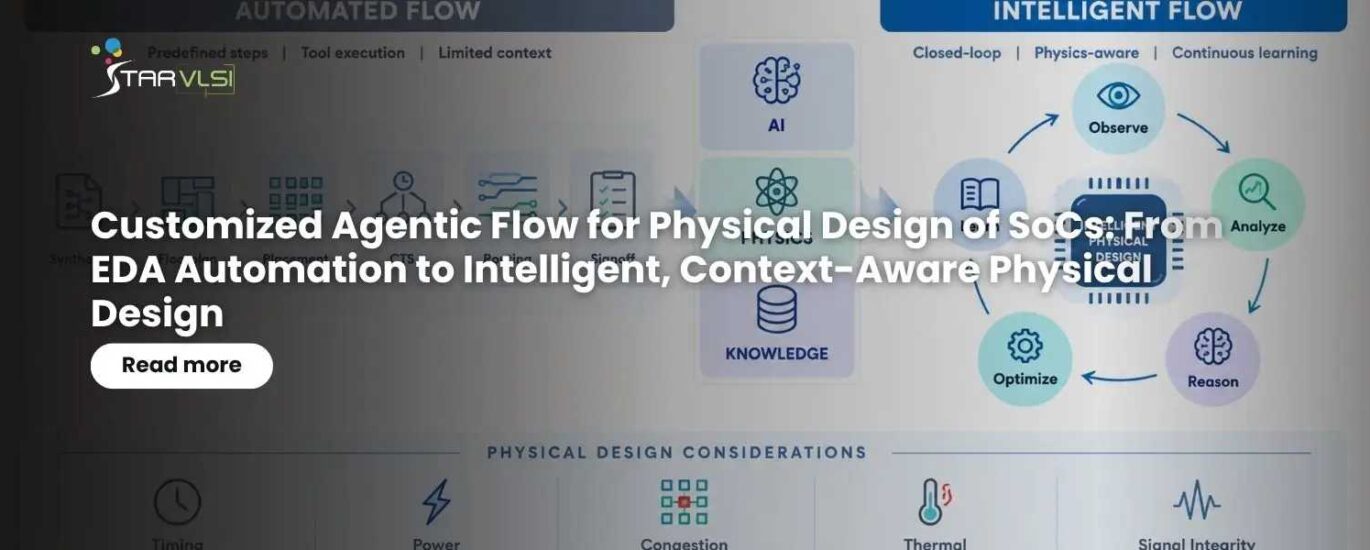
From Automated Flow to Agentic Flow
There is an important difference between traditional automation and agentic automation. A scripted flow might execute placement, generate a congestion report, run optimization and then generate a timing report — the sequence is predetermined irrespective of what happens during execution. An agentic flow operates as a feedback system: it observes implementation results, analyses problems, generates possible hypotheses, selects an appropriate action, executes that action and evaluates the outcome before deciding the next step.
Executes a predetermined sequence of commands regardless of the results at each stage.
Observes results, associates electrical behavior with its physical cause, and selects the next action accordingly.
For example, if a critical net shows unexpectedly large delay, the agent can examine the physical length of the net, extracted capacitance, resistance, fanout, coupling to neighboring nets and routing layers — distinguishing between a logic-delay problem and an interconnect-dominated problem. Similarly, if a power hotspot appears, the agent can correlate switching activity, current density, power-grid resistance, local IR drop and temperature rather than treating the problem simply as a power-report violation. This creates a closed-loop physical-design optimization system guided by both design metrics and physical understanding.
Architecture of a Customized Agentic Physical-Design Flow
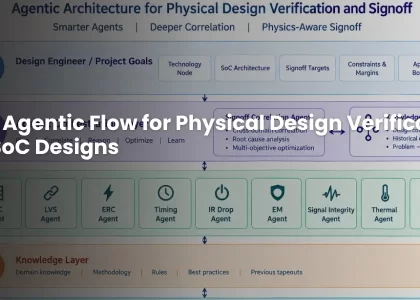
A practical agentic physical-design architecture can be organized around several interconnected layers:
The overall architecture therefore becomes:
This architecture can be customized for a particular company, technology node, SoC architecture or customer methodology.
Physics-Aware Agents Across the Physical-Design Flow
Within this architecture, specialized agents are assigned to each implementation stage — each reasoning about its stage's specific physical phenomena rather than just executing a fixed script:
Design Understanding Agent
Before optimizing physical implementation, an agent needs to understand the design from both a logical and physical perspective. The Design Understanding Agent can analyse the RTL hierarchy, synthesized netlist, clock domains, power domains, memory macros, IO requirements, IP blocks, timing constraints and physical constraints, and can classify blocks according to their expected physical behavior.
For example, a RISC-V-based SoC may contain processor cores, SRAMs, boot memory, DMA, interrupt controllers and high-speed interfaces. The agent can identify which blocks are likely to be timing critical, which generate significant switching activity and which interfaces may impose strong physical constraints. It can also identify structures sensitive to interconnect parasitics — long buses, high-fanout control signals, clock networks and high-speed interfaces — creating a physics-aware design context for the subsequent agents.
Floorplan Agent
The Floorplan Agent is responsible for generating and evaluating floorplan alternatives, considering die dimensions, core utilization, aspect ratio, macro placement, memory clustering, IO locations, power domains, clock distribution and routing requirements.
A physics-aware floorplan agent additionally considers the consequences of physical proximity. Placing high-switching blocks close together may increase local power density and thermal gradients; placing macros too close together may create routing bottlenecks and increase interconnect length elsewhere; sensitive analog or RF blocks may require physical isolation from noisy digital regions. The agent can therefore evaluate floorplans across timing, congestion, wire length, power density, thermal distribution, IR drop and routing feasibility — particularly important for advanced SoCs where floorplanning decisions can determine the eventual feasibility of timing, power and thermal closure.
Power Planning Agent
Power planning is fundamentally a physics problem — current must flow through finite-resistance metal structures, producing voltage drops and power dissipation. The Power Planning Agent can correlate power-domain information, power-grid topology, metal widths, via structures, switching activity and macro locations with IR drop and electromigration analysis.
When a power-integrity hotspot is detected, the agent can determine whether the problem is associated with local current demand, inadequate grid density, excessive metal resistance, via bottlenecks or macro placement. It can also consider the relationship between IR drop and transistor operating voltage — a local voltage reduction can change cell delay and potentially create timing violations, so power integrity and timing should not be treated as completely independent problems.
Placement Optimization Agent
Placement is a multi-objective optimization problem involving timing, congestion, power and routability. Physics-aware placement additionally considers the electrical consequences of physical distance and local density — the resistance and capacitance of interconnects increase with physical dimensions and routing conditions, so long critical nets can contribute significantly to delay and dynamic power.
The Placement Agent can monitor timing, congestion, wire length, parasitic estimates and switching activity and determine which parameter is currently limiting the implementation. If timing is acceptable but congestion is excessive, it can focus on improving cell distribution. If timing is dominated by interconnect delay, it can prioritize reducing the physical distance between communicating cells. If a region exhibits excessive switching activity and power density, it can consider spreading selected logic to reduce local thermal and power-density effects. The ability to select an optimization strategy based on the current physical state is one of the major advantages of an agentic approach.
Clock Tree Synthesis Agent
Clock networks are particularly sensitive to physical effects because clock signals must reach a large number of sequential elements with controlled skew, latency and transition. The CTS Agent can analyse clock skew, insertion delay, latency, transition, fanout, clock power and physical distribution, also considering wire resistance, capacitance and coupling effects that influence clock delay and waveform quality.
A physics-aware agent can recognize that simply reducing skew may not produce the best overall solution if it significantly increases clock power or routing congestion, and can therefore search for a balance between skew, latency, power, transition and physical resources. Clock shielding, routing-layer selection, buffer placement and spacing can also be treated as physical parameters affecting coupling and signal integrity.
Routing Agent
Routing is fundamentally an electromagnetic and electrical problem as well as a geometric one. Every routed wire has resistance and capacitance, while closely spaced wires can exhibit capacitive coupling; at higher frequencies and faster signal transitions, inductive effects and electromagnetic coupling can also become relevant.
The Routing Agent can classify DRC violations, shorts, opens, via-related problems, antenna violations, congestion and timing degradation while considering their physical origins. For example, excessive coupling between adjacent high-activity nets can produce crosstalk-induced delay or noise, and the agent can consider spacing, shielding, layer assignment or routing topology as possible corrective actions. A routing solution should not simply be the one with the fewest DRC violations — it should provide an electrically robust interconnect structure while satisfying timing, power, signal-integrity and manufacturability requirements.
Timing Closure Agent
Timing closure is one of the most promising applications of physics-aware agentic physical design. A Timing Closure Agent can correlate setup and hold violations with clock paths, data paths, cell delays, net delays, extracted RC, physical distances and routing conditions.
A critical path may be dominated by logic delay, but it may also be dominated by interconnect delay — in advanced technologies, the latter can become a significant component of total path delay. The agent can distinguish between these cases and select an appropriate corrective strategy: for an interconnect-dominated path, physical proximity, routing layer, buffering and wire topology may provide better solutions than simply upsizing logic cells; for a power-limited region, aggressive cell upsizing may improve timing but increase switching and leakage power. A physics-aware agent can recognize this trade-off and search for a solution that satisfies timing without creating unacceptable power or thermal consequences — a root-cause-driven timing closure loop based on both logical and physical behavior.
Signoff Agent
The Signoff Agent provides a consolidated view of the final implementation by integrating timing, IR drop, electromigration, DRC, LVS, antenna, signal integrity, power and thermal analysis. The key advantage is the ability to correlate apparently independent signoff results.
For example, a setup violation may be associated with increased interconnect resistance caused by routing congestion. A power hotspot may be associated with increased IR drop and temperature. A temperature increase may subsequently increase metal resistance and cell delay. Such interactions can create complex feedback loops that are difficult to identify by looking at individual reports — the Signoff Agent can therefore provide an engineering-level assessment that considers these interactions rather than simply reporting whether individual checks passed or failed.
Knowledge Graph for Physical Design
A customised agentic system requires more than a general-purpose Large Language Model. The organization needs to provide its own engineering knowledge as well as the physical relationships that govern implementation. A Physical Design Knowledge Graph can capture relationships between designs, IPs, constraints, technologies, tools, configurations, violations, physical phenomena, root causes and corrective actions.
For example, a congestion problem can be associated with placement density, macro channels, routing-layer utilization and parasitic impact. A timing violation can be associated with cell delay, net delay, physical distance, RC extraction and coupling. An IR-drop problem can be associated with current density, power-grid resistance, temperature and timing impact. This allows the agent to reason across multiple physical domains instead of treating each EDA report independently — over time, the knowledge graph can become a digital representation of the organization's physical-design expertise.
RAG for Physical Design
Retrieval-Augmented Generation, or RAG, can provide agents with access to the organization's existing documentation and project experience. The RAG repository can contain physical-design methodology documents, PDK guidelines, EDA tool documentation, internal flow manuals, previous project reports, timing-closure examples, floorplan studies, DRC-debugging information and engineering recommendations.
For a physics-aware methodology, the knowledge base can also include semiconductor-device behavior, interconnect models, RC extraction concepts, electromigration rules, thermal considerations, signal-integrity guidelines and technology-specific physical effects. When an agent encounters a problem, it can retrieve the relevant engineering knowledge before proposing an action — making the agent organization-specific, methodology-aware and physics-aware, rather than simply dependent on generic AI knowledge.
Connecting AI Agents to EDA Tools
The intelligence of an agentic system becomes useful only when agents can interact with the actual EDA environment. A controlled tool-agent layer can expose synthesis, floorplanning, placement, CTS, routing, extraction, STA, power, thermal and physical-verification capabilities through well-defined interfaces.
The EDA tools remain responsible for accurate physics-based computation. The AI agent should not attempt to replace detailed RC extraction, field solving, STA, IR-drop analysis or signoff engines with an LLM — instead, the agent should use these engines as physics oracles and reason over their results:
This distinction is critical: AI provides reasoning and orchestration, while established EDA engines provide the accurate physical modeling required for silicon implementation.
Closed-Loop Physical-Design Optimization
The most powerful capability of the architecture is the closed-loop optimization mechanism. The agent first establishes a plan based on the current implementation state, executes the required EDA operation, measures the resulting metrics, analyses the changes, diagnoses the remaining problems and determines the next optimization step. A physics-aware optimization loop can consider:
These objectives are strongly coupled. Increasing cell sizes may improve timing but increase power and congestion. Increasing wire spacing may improve signal integrity but consume routing resources. Adding power straps may improve IR drop but increase routing congestion. Moving macros may improve congestion but increase interconnect length. The agent must therefore reason about trade-offs rather than isolated metrics, effectively converting physical design into a multi-objective optimization problem managed through intelligent agents and physics-based evaluation engines.
Human-in-the-Loop Physical Design
Agentic physical design should not mean completely autonomous chip implementation. Silicon design has engineering, reliability and manufacturing consequences that require human accountability. Engineers should define the design objectives, technology constraints, reliability requirements, acceptable optimization ranges, methodology rules and final signoff criteria — as well as which physical approximations are acceptable during exploration and which decisions must always be validated by accurate signoff engines.
Within these boundaries, agents can perform experimentation and optimization. A practical model is:
This provides the productivity advantages of AI while retaining experienced engineering oversight.
Learning From Every Implementation
One of the greatest long-term advantages of agentic physical design is the ability to preserve engineering experience. In conventional projects, valuable knowledge about why a particular floorplan worked, how a difficult timing problem was solved, how an IR-drop hotspot was eliminated or why a routing strategy reduced crosstalk may remain with individual engineers. An agentic system can capture the relationship between the problem, physical cause, corrective action and measured result.
For example, if increasing the channel between two SRAM clusters reduces congestion and interconnect parasitics without degrading timing, that result can become part of the organization's reusable knowledge. Similarly, if a particular power-grid configuration consistently reduces IR drop in a high-switching region, the relationship between the physical structure and the resulting electrical behavior can be retained. When a future SoC exhibits a similar physical pattern, the agent can retrieve this previous experience and use it as one of the candidate solutions — the physical-design flow therefore becomes a learning engineering system that accumulates both design experience and physics-aware implementation knowledge.
Customization for Different SoC Domains
The agentic framework should be adapted to the characteristics of the target SoC:
The same agentic architecture can therefore support different SoC domains by changing the knowledge base, physics models, objectives, constraints and optimization policies.
Developing the Agentic Flow Incrementally
A practical organization should not attempt to build a completely autonomous physics-aware physical-design system in one step:
Measuring the Value of Agentic Physical Design
The success of an agentic flow should not be measured simply by whether an AI model can generate Tcl scripts. More meaningful metrics include reduction in physical-design iterations, reduction in timing-closure time, improvement in PPA, reduction in engineer debug effort, faster DRC and IR/EM closure, better thermal behavior, improved signal integrity and increased reuse of previous implementation knowledge.
Another important metric is the quality of root-cause analysis — an agent that can explain why a violation occurs is considerably more valuable than one that simply identifies that a violation exists. Ultimately, the objective is to reduce engineering cycle time while improving implementation quality and physical robustness.
The Future of Intelligent Physical Design
The future of SoC physical design is likely to move from a tool-centric methodology toward an intent-centric and physics-aware methodology. Today, engineers often think in terms of which EDA command should be executed next. An agentic environment changes the focus toward the design objective and the physical mechanisms that determine whether that objective can be achieved.
EDA engines will remain essential. AI does not replace synthesis, placement, routing, extraction, timing, power or signoff engines — instead, AI becomes an intelligent reasoning and orchestration layer above the EDA tools, while physics-based engines provide accurate evaluation of the proposed implementation. The combination of EDA Engines, AI Agents, Knowledge Graphs, RAG, Design Data, Physics Models, Optimization Algorithms and Human Expertise can create a new generation of physical-design methodology.
The most advanced systems may eventually develop a digital representation of the SoC that combines logical connectivity with physical, electrical and thermal behavior — allowing agents to reason about how a change in one domain propagates into another.
Conclusion
Customised agentic physical-design flows represent an important evolution beyond conventional EDA automation. The real opportunity is not simply to use an LLM to generate scripts, but to create an intelligent system that understands the design context, methodology, constraints, tool behavior, physical phenomena and historical engineering knowledge.
For organizations developing multiple SoCs, such a system can progressively convert years of physical-design experience into a reusable digital engineering asset. The ultimate vision is a Silicon Engineering Agent that understands design intent, orchestrates EDA tools, diagnoses problems using physical evidence, explores alternatives, learns from implementation results and continuously drives the design toward PPA, reliability and signoff objectives.
Agentic AI therefore has the potential to transform physical design from a sequence of tool executions into an intelligent, physics-aware, learning and continuously optimizing engineering process, with experienced silicon engineers remaining at the center of the decision-making loop.
Build Physics-Aware Physical Design Expertise with StarVLSI
StarVLSI provides industry-oriented training in physical design, timing closure, power integrity, and the emerging AI-driven methodologies reshaping modern SoC implementation.
Explore StarVLSI CoursesStay connected with the StarVLSI Blog for more in-depth articles on physical design, AI in EDA, and emerging technologies shaping the future of the semiconductor industry.