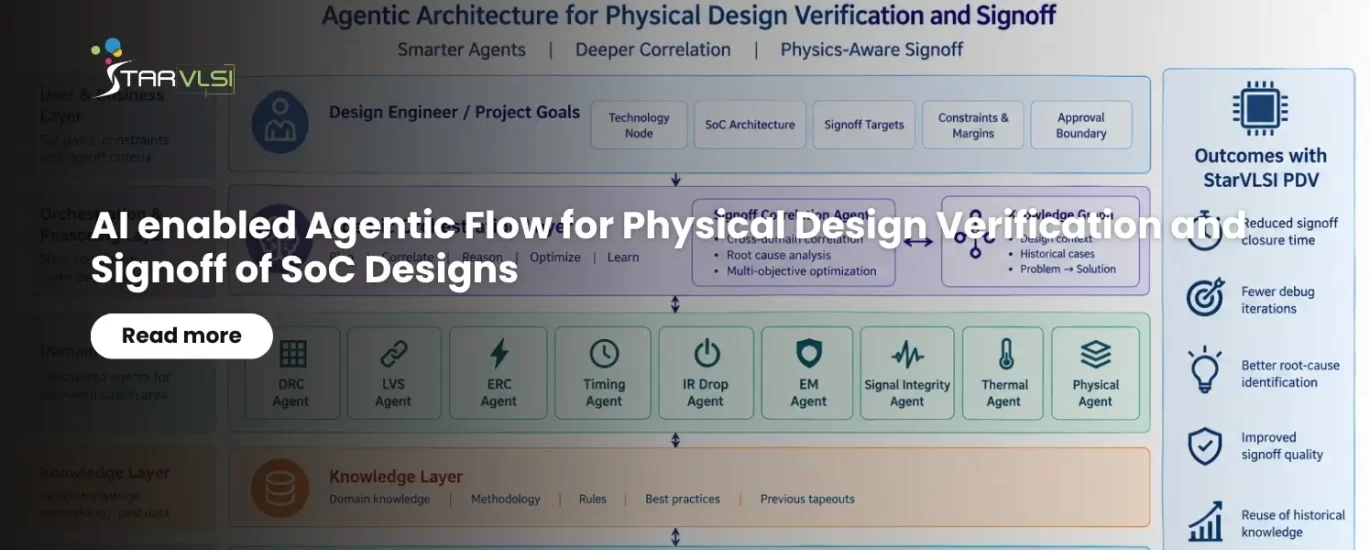
AI-Enabled Agentic Flow for Physical Design Verification and Signoff of SoC Designs
DRC, LVS, ERC, STA, signal integrity, power integrity, electromigration, IR drop, and thermal analysis are traditionally treated as separate reports that an engineer manually correlates. This article covers how a physics-aware agentic verification flow instead correlates violations across all these domains automatically — tracing a timing violation back through congestion, IR drop, or thermal effects to its actual physical root cause — while experienced engineers retain final signoff authority.
Signoff Is Becoming the Most Knowledge-Intensive Stage of SoC Development
As SoC designs move toward advanced process nodes and increasingly complex architectures, physical design verification and signoff have become some of the most demanding stages of semiconductor development. A modern SoC may contain billions of transistors, multiple voltage domains, high-speed interfaces, embedded memories, complex clock networks and increasingly dense interconnect structures.
At these technology nodes, in addition to achieving a clean layout, the physical implementation must satisfy many electrical, physical, timing, reliability and manufacturing requirements. Design Rule Checking (DRC), Layout Versus Schematic (LVS), Electrical Rule Checking (ERC), Static Timing Analysis (STA), Signal Integrity (SI), power integrity, Electromigration (EM), IR drop, thermal analysis and other signoff activities must converge before tapeout. Traditionally, these activities are performed through predefined verification flows — EDA tools generate large volumes of reports, and experienced engineers analyse violations, determine root causes, modify the design or constraints and rerun the appropriate checks.
With the emergence of Agentic AI, this process can evolve into an intelligent, context-aware and physics-aware verification and signoff system. The objective is not simply to automate the execution of signoff tools, but to create an intelligent system that can understand the design, correlate violations across multiple analyses, identify probable root causes, recommend corrective actions, execute controlled verification iterations and learn from previous signoff experience.
Agentic Approach to Physical Design Verification
Physical design verification is inherently a multi-dimensional problem. A single physical change can affect several signoff parameters simultaneously. Widening a power strap may improve IR drop but consume routing resources. Increasing spacing between signal wires may reduce crosstalk but increase routing congestion. Moving a macro may improve timing but increase the length of other critical nets. Increasing cell size may improve setup timing while increasing power and local congestion.
Individual signoff reports therefore cannot always be treated independently. A conventional flow may report a timing violation, an IR-drop violation and a congestion violation as three separate problems — an experienced engineer may recognize that all three originate from the same physical region. An agentic verification flow can establish these relationships automatically. The system can ask:
This ability to correlate multiple sources of evidence is one of the key advantages of an intelligent signoff methodology.
From Automated Verification to Intelligent Verification
Traditional verification automation primarily follows a predefined sequence:
The sequence is automated, but the engineering reasoning remains largely manual. An agentic verification flow introduces an intelligent decision layer between the verification stages:
The agent does not simply identify that a violation exists — it attempts to understand the physical and logical conditions that created the violation. For example, if a setup violation occurs on a critical path, the agent can correlate the timing report with placement information, extracted resistance and capacitance, congestion, clock skew and routing topology. If the dominant contributor is interconnect delay, the agent can distinguish this from a cell-delay problem. If the same region also exhibits high IR drop, the agent can investigate whether supply-voltage degradation is contributing to timing loss. The result is a root-cause-oriented verification flow rather than a collection of independent signoff checks.
Architecture of a Customised Agentic Verification and Signoff Flow
A customised agentic verification architecture can be constructed around several interconnected layers:
The overall concept can be represented as:
This architecture can be customized for a specific technology node, SoC architecture, foundry methodology or organization's signoff methodology.
Physics-Aware Verification Agents
Within this architecture, specialized agents are assigned to each class of signoff analysis:
Design Understanding Agent
The first requirement for intelligent verification is understanding what is being verified. The Design Understanding Agent builds a context model of the SoC by analysing the netlist, layout, hierarchy, clocks, power domains, macros, IOs, constraints and critical interfaces. It can identify important physical regions such as processor clusters, SRAM arrays, high-speed interfaces, clock networks and power domains — providing context for subsequent verification. A violation in a high-speed interface region may have very different implications from a similar violation in a low-speed control block, and a timing violation near a large memory macro may be associated with routing limitations or macro placement. The agent therefore establishes the design context before interpreting the verification results.
DRC Verification Agent
Design Rule Checking ensures that the physical layout satisfies the manufacturing rules defined for the technology. At advanced nodes, DRC can involve a very large number of geometric and process-dependent rules — violations may relate to spacing, width, enclosure, density, patterning and other manufacturing constraints. A DRC Verification Agent can classify violations, identify their spatial distribution and correlate them with the physical structures responsible. Instead of presenting thousands of violations as a flat list, the agent can group them into meaningful clusters — hundreds of similar violations concentrated around a particular routing structure can be treated as one underlying methodology problem rather than hundreds of independent errors, significantly improving DRC closure efficiency.
LVS and ERC Verification Agents
Layout Versus Schematic verification establishes whether the physical implementation corresponds correctly to the intended logical design. An LVS failure may originate from missing connections, incorrect connectivity, device mismatches, shorts, opens or hierarchy-related problems. The LVS Agent can analyse the error classification and trace the problem through the physical and logical representations of the design, helping identify the likely location and category of a mismatch and correlating it with recent layout modifications — particularly valuable during late-stage ECOs, where a small physical modification can unintentionally affect connectivity.
Electrical Rule Checking verifies whether the implemented design satisfies important electrical connectivity and reliability rules. The ERC Agent can investigate issues such as illegal connections, power-domain problems, floating structures, improper control signals and other technology-specific electrical conditions. For multi-voltage SoCs, the agent can additionally understand the relationship between power domains, level shifters, isolation structures and power-intent information, allowing ERC verification to become more context-aware rather than simply rule-based.
Timing Signoff Agent
Static Timing Analysis is one of the most important components of physical signoff. The Timing Signoff Agent can analyse setup and hold timing, clock skew, insertion delay, path delay and timing margins while correlating these results with physical implementation information. A timing violation can be classified according to whether it is primarily caused by logic delay, cell delay, interconnect delay, clock behavior, congestion or power-related effects.
This is where physics-aware reasoning becomes particularly important. A long interconnect has resistance and capacitance. Closely spaced interconnects can introduce coupling capacitance. A high-resistance power network can cause local voltage degradation, which can influence cell delay. Temperature can also influence electrical characteristics. The agent should therefore not interpret timing purely as a logical property — it should understand timing as the product of device characteristics + interconnect physics + clock behavior + operating conditions.
Parasitic Extraction Agent
Parasitic extraction provides the electrical representation of the physical layout. The Extraction Agent can monitor extracted resistance and capacitance and identify nets whose parasitic behavior has changed significantly during implementation, correlating extracted values with wire length, routing layer, geometry, fanout and neighboring structures. If a critical net has unexpectedly high capacitance, the agent can investigate whether the cause is excessive wire length, coupling with neighboring nets or routing geometry, then provide this information to the Timing or Signal Integrity Agent for further analysis.
IR Drop Verification Agent
Power integrity is fundamentally governed by physics — current flowing through a finite-resistance power network produces voltage drop, and its magnitude and distribution depend on power-grid topology, metal dimensions, via structures, current demand and switching activity. The IR Drop Agent can identify voltage-drop hotspots and correlate them with high-current regions, power-grid structures and placement density, and, more importantly, determine whether the IR drop is influencing other signoff parameters. For example:
An agentic flow can recognize this chain rather than treating IR drop and timing as independent reports.
Electromigration Verification Agent
Electromigration occurs when high current density causes gradual movement of metal atoms, potentially degrading interconnect reliability. The EM Agent can analyse current density across power and signal networks and identify locations where current exceeds acceptable limits. A physics-aware agent can correlate current density with metal width, via structures, temperature and local power demand — temperature is especially important, since electromigration behavior is strongly influenced by thermal conditions, so EM signoff can be connected to thermal analysis rather than treated as an isolated verification activity.
Signal Integrity Agent
Signal integrity becomes increasingly important as signal transitions become faster and interconnects become denser. The Signal Integrity Agent can analyse crosstalk, noise, coupling capacitance, delay variation and potentially inductive effects where relevant, identifying aggressor-victim relationships between nets and determining whether physical spacing, shielding, routing-layer selection or buffering can reduce the problem. A timing violation caused by coupling may require a different corrective action from one caused by excessive wire resistance — the agent can distinguish electrical root causes from purely geometric problems.
Thermal Verification Agent
As SoCs integrate high-performance processors, AI accelerators and other compute-intensive blocks, thermal behavior becomes an increasingly important physical-design consideration. A thermal agent can correlate power density with physical location and identify hotspots. The importance of thermal analysis extends beyond temperature itself — increased temperature can influence leakage, transistor performance, metal resistance and reliability, so a thermal hotspot may contribute indirectly to timing degradation, IR drop and electromigration. A physics-aware agent can recognize these dependencies and feed thermal information into the relevant signoff agents.
Physical Verification Agent
The Physical Verification Agent acts as a higher-level coordinator across DRC, LVS, ERC and other physical checks. Rather than treating each violation independently, it can construct a spatial and hierarchical view of the design — if DRC violations, routing congestion and signal-integrity problems all occur in the same physical region, the agent can recognize that they may have a common root cause. This transforms physical verification from a rule-checking activity into a design-understanding activity.
Signoff Correlation Agent
The Signoff Correlation Agent is perhaps the most important component of the intelligent verification architecture. Modern SoC signoff produces information from many independent analysis engines — the challenge is not merely generating these reports but understanding their relationships. The correlation agent can build relationships such as:
Such correlations allow the system to move from symptom detection to root-cause analysis.
Knowledge Graph for Verification and Signoff
A customized agentic system requires a knowledge representation that captures both verification methodology and engineering experience. A Signoff Knowledge Graph can connect design blocks, physical locations, violations, technology rules, operating conditions, EDA tools, previous solutions and resulting signoff metrics. For example, the graph can capture that a particular DRC pattern has previously been associated with a specific routing configuration, or that a particular timing violation was successfully resolved by reducing interconnect length rather than increasing cell size. Over time, the knowledge graph becomes a digital representation of the organization's signoff expertise — particularly valuable because signoff knowledge accumulated over multiple projects can be reused on future designs.
RAG for Verification and Signoff
Retrieval-Augmented Generation can provide agents with access to the organization's signoff documentation and historical experience. The RAG repository can contain foundry design-rule documentation, signoff methodology, tool manuals, internal verification procedures, previous tapeout reports, DRC debug cases, LVS debug information, timing-closure examples and engineering guidelines. When an agent encounters a new violation, it can retrieve similar historical cases before proposing a corrective action — combining general AI reasoning with organization-specific semiconductor expertise.
Connecting AI Agents to Signoff Tools
AI agents must ultimately interact with real EDA signoff engines. However, an LLM should not attempt to replace the physics-based algorithms used by established EDA tools. DRC engines perform accurate geometric rule checking, parasitic extraction engines calculate physical electrical characteristics, STA engines perform timing propagation, and IR-drop and EM tools perform detailed electrical analysis — these tools should remain authoritative physics and signoff engines, with the AI layer providing intelligence around them:
This creates a controlled and auditable connection between AI reasoning and signoff computation.
Closed-Loop Signoff Optimization
Traditional signoff closure often involves repeated manual iterations — an engineer examines a violation, modifies the design, reruns one or more analyses and then checks whether the change created new problems elsewhere. An agentic flow can manage this loop systematically: the agent establishes the current signoff state, identifies the highest-impact problem, proposes one or more corrective actions, executes a controlled experiment and evaluates the complete signoff state after the modification.
Importantly, the evaluation should not consider only the parameter that was being optimized — if a timing improvement creates unacceptable power, congestion or IR-drop degradation, the candidate should be rejected. This creates a multi-objective signoff optimization process.
Physics-Aware Signoff
Physics awareness is particularly important for agentic verification because the underlying silicon behavior cannot be represented completely by textual reports. The agent needs to understand that the physical implementation creates electrical behavior: interconnect geometry determines resistance and capacitance; neighboring wires determine coupling; current flow determines IR drop and electromigration stress; power density influences temperature; temperature influences electrical and reliability behavior. A physics-aware agentic system should therefore connect:
This is an important step toward developing an intelligent physical-design methodology that goes beyond conventional AI-assisted scripting.
Human-in-the-Loop Signoff
Signoff is ultimately an engineering responsibility and should not become an uncontrolled autonomous process. Experienced engineers need to define the signoff criteria, acceptable margins, technology constraints, reliability requirements and approval boundaries. The agent can perform analysis and optimization within these boundaries while escalating important or ambiguous decisions to engineers. A practical model is:
This approach combines the speed of AI with the accountability and judgment required for silicon development.
Learning From Every Signoff Cycle
Every signoff iteration represents valuable engineering knowledge. If a particular DRC violation is solved by modifying a routing constraint, the system can record the relationship between the violation and the solution. If a timing problem is resolved by improving macro placement, that experience can be captured. If an IR-drop problem is caused by a localized power-density hotspot, that relationship can also become part of the knowledge base. Over multiple projects, the system can accumulate a large library of problem → physical cause → corrective action → measured result relationships — allowing future projects to benefit from previous signoff experience.
Customisation for Different SoC Domains
The signoff agents should be customized according to the characteristics of the target SoC:
The agentic framework should therefore be domain-aware and technology-aware, rather than being a generic verification assistant.
Developing the Agentic Flow Incrementally
A practical organization should build the agentic verification methodology in stages:
Measuring the Value of Agentic Signoff
The success of an agentic verification flow should not be measured by how many reports an AI system can summarize. More meaningful measures include reduction in signoff closure time, reduction in debug iterations, improvement in root-cause identification, reduction in manual report analysis, faster DRC/LVS closure, faster timing closure, improved power-integrity closure and improved reuse of historical signoff knowledge.
Another important measure is the ability to identify cross-domain problems — an agent that can recognize that a timing violation is actually related to congestion, IR drop or thermal behavior provides significantly more value than an agent that simply reports a negative timing margin. Ultimately, the objective is to achieve faster, more reliable and more predictable tapeout closure.
The Future of Intelligent Physical Design
The future of SoC verification is likely to evolve from independent signoff engines toward an integrated intelligent signoff ecosystem. EDA tools will continue to perform the detailed physics-based computations required for accurate silicon validation, while AI agents increasingly operate above these tools, connecting their results and reasoning about the relationships between physical, electrical, thermal and reliability effects. The future system could maintain a continuously updated digital representation of the SoC containing:
An intelligent agent could then reason about the consequences of a proposed physical modification before executing the appropriate EDA verification. This represents a transition from:
Conclusion
Physical design verification and signoff are among the most knowledge-intensive activities in SoC development. As designs become more complex and technology nodes continue to shrink, the interactions between geometry, electrical behavior, thermal effects, reliability and manufacturing become increasingly important. A customised agentic verification flow can bring intelligence to this process by combining AI agents, EDA signoff engines, physics-based analysis, knowledge graphs, RAG, historical design data and human engineering expertise.
The real opportunity is not to replace established signoff tools. It is to build an intelligent layer that can understand their results, correlate information across domains, identify physical root causes and intelligently drive the next verification iteration. The ultimate vision is a Silicon Signoff Agent that understands the design context, monitors verification status, correlates DRC, LVS, timing, power, signal integrity, thermal and reliability information, learns from previous tapeouts and continuously guides the SoC toward a robust signoff state.
Agentic AI can therefore transform physical verification and signoff from a report-driven closure process into an intelligent, physics-aware and learning-based engineering methodology — bringing the industry closer to faster and more predictable first-time-right silicon.
Explore AI-Enabled Signoff Methodology with StarVLSI
StarVLSI brings together practical VLSI design knowledge, physical-design expertise and emerging AI-based methodologies to explore the next generation of intelligent silicon engineering.
Subscribe to StarVLSISubscribe to StarVLSI for more practical insights on AI-enabled SoC design and verification.